
How to Find the Right effort Level for Exercise
- Dawn Roe
- Apr 24
- 4 min read
Updated: Apr 27
Finding the right level of exercise is not about pushing as hard as possible. It is about choosing an effort that allows you to breathe, move well, stay in control, and build progress safely over time.

One of the most important parts of exercise is getting the effort level right.
Too easy, and the body is not asked to adapt. Too hard, and quality starts to disappear.
That is where many people come unstuck.
They assume exercise only “counts” if it feels very hard. Or they try to match what they did last week, even if today is a different sort of day.
But sensible exercise does not work like that.
The right level is not about proving something. It is about finding an effort that helps you move well, stay in control, and develop capacity.
It is not about pushing as hard as possible
Many people have grown up with messages like:
“No pain, no gain.”
“Push through.”
“Do more than last time.”
That way of thinking can be unhelpful.
In my experience, people often struggle not because they are doing too little, but because they are trying too hard. When effort goes too high, breathing changes, tension increases, and movement quality often gets worse.
That rarely builds confidence or skill.
A better aim is this:
work at a level that is useful, sustainable, and repeatable.
Breathing is one of your best guides
One of the simplest ways to judge the right level is to notice your breathing.
Before you begin, notice how your breathing feels at rest.
Then, as you start moving, ask yourself:
can I still breathe fairly easily?
am I holding my breath?
can I speak in short sentences?
A gentle increase in breathing is normal.
But if you find yourself holding your breath, straining, rushing, or no longer able to speak comfortably, the exercise may be too demanding at that moment.
That is not failure.
It is feedback.
Your breathing is one of your built-in guides. It can tell you a lot about whether the movement, effort, or pace is right for you that day.
The sweet spot is often lower than people think
In my classes, the right effort level is around 4 to 6 out of 10 (or 40-60%).
That means you feel warm, focused, and aware that you are working, but still in control.
You are not collapsing into the effort.
You are not gritting your teeth just to get through it.
You are not using up everything you have.
You still need something left in the tank for the rest of the day.
That matters.
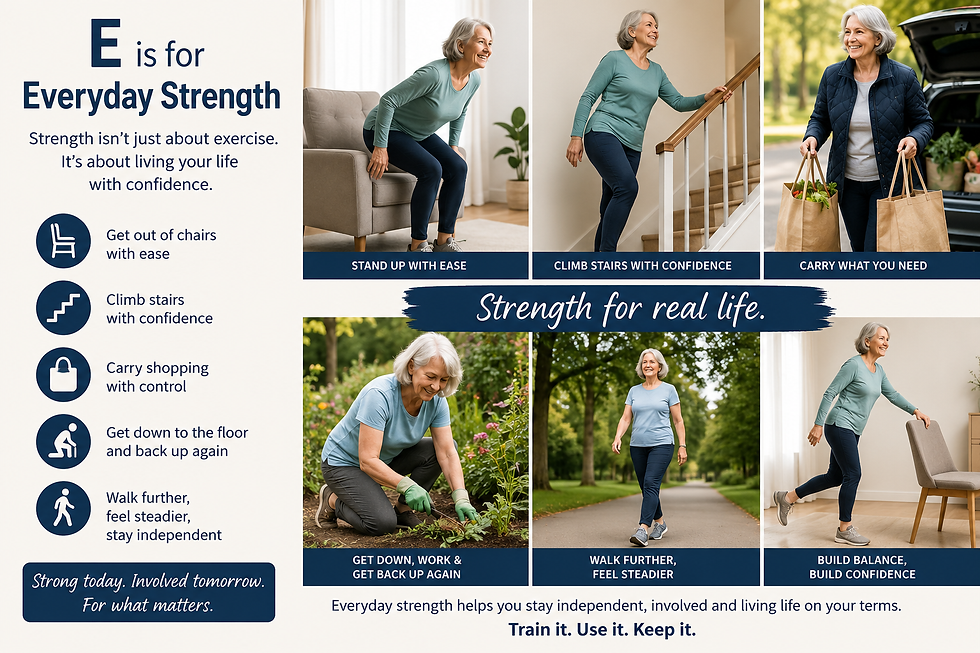
Because most people are not training for sport. They are training for stairs, walking, getting up from chairs, carrying things, turning, and staying involved in everyday life.
The talk test is useful too
A very practical guide is the talk test.
At the right level, you should usually still be able to speak in short sentences.
If you cannot talk comfortably, or if breathing becomes strained, it is often a sign that the effort is too high, the task is too complex, or the day’s capacity is simply lower than usual.
And sometimes that happens.
Today’s capacity may be different
Not every day feels the same.
You may be tired, Recovering from illness, Stressed, Below par, Or simply having an off day.
That is normal.
Being well enough to exercise does not always mean feeling 100 per cent. It means being able to adjust appropriately and take part safely.
The aim is not to match last week’s performance regardless of how you feel.
The aim is to work at the right percentage of your current capacity.
Some days that will mean doing less, but still doing it well.
That is not a backward step.
That is good judgement.
progression works better when it is calm not forced
Progress matters.
But progression should not mean pushing on for the sake of it.
A useful progression is usually small and controlled and can include one of the following:
a little more range
a little more load
a little less support
a little more complexity
while still keeping:
easy breathing
good control
and a reasonably relaxed body
If an exercise makes you hold your breath, tense your shoulders or jaw, or feel flustered and rushed, it is often too big for today.
The answer is usually:
same exercise, smaller dose, better control.
Then build again from there.
That is how confidence grows.
Off days do not mean failure
There will be days when the full session is not the right choice.
Sometimes the sensible answer is to:
shorten the session
reduce the effort
choose something more familiar
or pause and restart gently another day
That is not weakness.
It is self-regulation.
And self-regulation is an important skill.
Long-term progress is not built by forcing every session. It is built by returning again and again at a level that helps rather than harms, and adjusting to suit in each moment.
Good exercise should help you trust your body more
To me, the right level of exercise is not the one that leaves people feeling defeated.
It is the one that helps them feel:
capable
steadier
clearer about what their body can do
and more willing to come back and do it again
That is the point.
Because the best exercise programme is not the one that looks hardest on paper.
It is the one that helps people move better, build safely, and continue consistently enough for progress to happen.
A simple question to ask
Next time you exercise:
Can I still breathe, move well, and stay in control here?
If the answer is yes, you are probably much closer to the right level than you think.
Enjoyed this article?
Join The Strong, Steady & Involved Letter for practical strength, balance and confidence tips by email, plus updates about classes, workshops and new resources.


Comments