
E is for Everyday Strength
Strength is often misunderstood.
People hear the word strength and associate it with gyms, heavy weights, young athletes, mirrors, machines, and people pushing themselves to the limit.
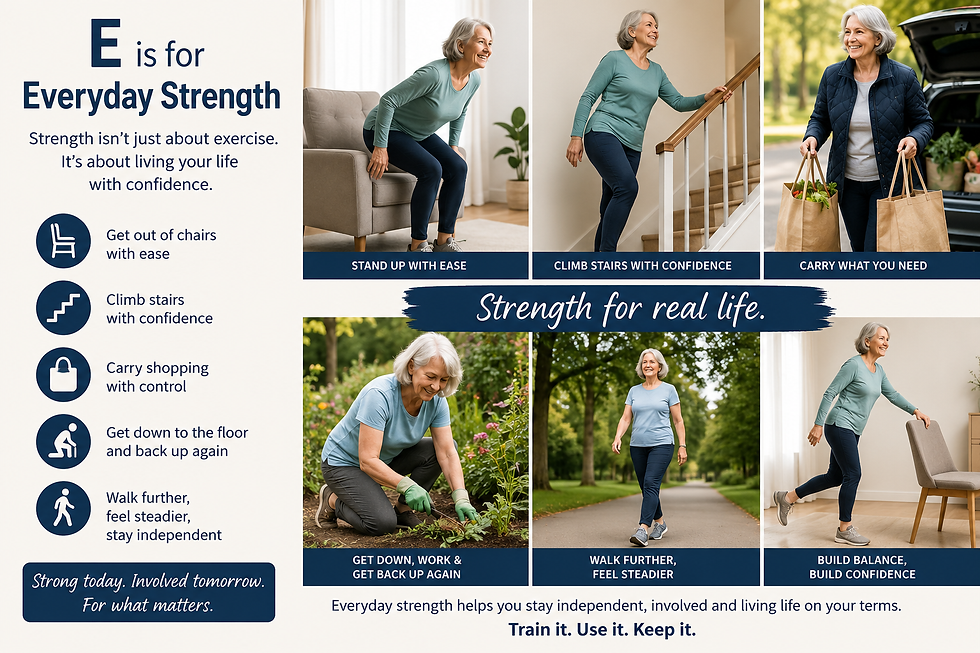
for adults 55+, strength is much more practical than that.
Strength is:
getting out of a chair without a struggle.
climbing the stairs with more confidence.
carrying shopping from the car.
getting up from the floor.
walking uphill without feeling defeated before you start.
being able to keep doing ordinary things with more ease, control and independence.
That is why, in the STEPS approach, E is for Everyday Strength.
Because the strength that matters most is the strength that helps people live their real lives.
Strength is not just about muscles
Muscles matter, of course. But everyday strength is also about bones.
When muscles work, they pull on the bones.
When we stand, step, lift, carry, push, pull or rise from a chair, we place useful load through the body.
Bones need appropriate loading to help them stay strong. That is one of the reasons strength work becomes so important as we get older.
So when we train everyday strength, we are not just training isolated muscles.
We are supporting muscle strength, bone health, posture, balance, confidence and independence.
everyday strength is about how the whole body working together.
To get out of a chair, you need:
feet placed well
ankle movement
leg strength
hip strength
trunk control
balance
confidence
timing
breathing
the ability to control how your weight moves over support and feet.
That is a lot happening in one everyday movement.
To climb stairs, you need leg strength, balance, coordination, foot clearance, confidence and enough energy to repeat the movement safely.
To carry shopping, you need grip strength, arm strength, posture, trunk control, leg strength, balance and the ability to keep breathing while the body is working.
So when we train everyday strength, we are not just training isolated muscles.
We are training useful movement.
Everyday strength protects independence
One of the reasons strength matters so much is that it supports independence.
When strength starts to reduce, life often becomes smaller in quiet ways.
People may begin to:
avoid certain stairs
push up heavily from chairs
choose not to carry much
avoid kneeling or getting down to the floor
stop gardening as much
avoid longer walks
feel less confident going out alone
rely more on other people for ordinary tasks
this rarely happens overnight.
It creeps in.
The body adapts. The person adapts. Life adapts.
But those small changes can add up.
Strength training gives people a way to push back against that decline.
Not by pretending they are 25 again.
Not by forcing the body.
But by gradually rebuilding the strength needed for ordinary, meaningful life.
Sit to stand is strength training
One of the most useful strength exercises is also one of the most ordinary: getting up from a chair.
It sounds simple, but it is powerful. In everyday life, it is our version of a squat.
The sit-to-stand movement is connected to so many daily activities.
Every time someone gets out of a chair, off the toilet, out of the car, or up from a bench, they are using a version of that pattern.
Training sit to stand well can improve:
leg strength
hip strength
balance
confidence
weight shift
control
stamina for repeated daily movement
But it needs to be done with awareness.
No flinging the body forwards
No holding the breath
No collapsing back into the chair
No relying only on momentum.
Good practice might begin with a higher chair, hands used for support, fewer repetitions, and a slower pace.
Then, as confidence and strength improve, the movement can gradually be progressed by adjusting one of these factors.
Again, the aim is useful practice.
Not showing off.
Strength needs the right level of challenge
Everyday strength improves when the body is challenged at the right level.
Too easy, and the body has little reason to adapt.
Too hard, and movement quality, confidence and safety can suffer.
That is why the starting point matters.
For one person, strength training may mean standing from a chair with both hands assisting.
For another, it may mean using one hand.
For another, it may mean standing without hands.
For another, it may mean adding slower control, more repetitions, a lower chair, a pause, or a small amount of extra load.
The exercise may look similar from the outside, but the level of challenge can be very different.
That is intelligent training.
The question is not, “Is this exercise hard?”
The better question is, “Is this the right level of challenge for this person today?”
Effort matters
Strength work should feel like work, yet not reckless.
For many older adults, especially in a group setting, a useful working effort might sit around 4-6 out of 10.
That means the person is working, but still able to:
breathe steadily
keep good technique
listen to instructions
notice what the body is doing
stop before control disappears
There may be times when effort rises, especially during strength work, but the body should not be pushed into panic, breath-holding or poor movement.
Signs that the effort may be too high include:
gripping hard with the hands
holding the breath
rushing
face tightening
shoulders lifting
losing posture
feeling unable to listen or adjust
needing to collapse into the chair or support
Those signs are feedback, not failure, and The sensible response is to modify.
The exercise can be modified:
Reduce the repetitions
Use more support
Make the movement smaller
Slow it down
Take a longer rest
Return to a more familiar version if needed
That is training wisely.
Strength and balance belong together
Strength and balance are often spoken about separately, but in real life they are closely linked.
If the legs are not strong enough, balance becomes harder.
If the hips cannot support the body well, stepping and recovering become harder.
If the ankles and feet are weak or stiff, balance reactions can become slower or less effective.
If the trunk cannot help organise the body, movement may become less steady.
Balance depends on movement, body awareness and information from the feet, joints, eyes and inner ear working together.
Strength gives the body options.
Together, they help a person respond to real life.
That might mean catching themselves after a small wobble, stepping sideways to avoid an obstacle, standing up without needing to pull heavily on furniture, or walking with more confidence on uneven ground.
Strength is also about bone and muscle health
As we get older, strength training becomes even more important.
Muscles need regular use to stay useful.
Bones also respond to appropriate loading.
This does not mean everyone needs to lift heavy weights or do complicated gym routines.
But the body does need enough challenge to remind the muscles and bones that they are still needed.
That might include:
repeated sit to stands
heel raises
supported squats
step-ups
hip strengthening
resisted arm movements
carrying appropriate loads
controlled floor-to-stand practice where suitable
The details depend on the person, their health, their confidence, and their starting point.
But the principle is simple.
Use it wisely, or gradually lose it.
Strength should feel useful
The best strength training for older adults should make sense.
People are more likely to commit when they understand why they are doing something.
A heel raise is not just a heel raise.
It helps with push-off when walking, stair climbing, ankle strength and balance reactions.
A sit to stand is not just a class exercise.
It helps with chairs, toilets, cars, benches and independence.
A step-up is not just a step-up.
It connects to stairs, kerbs, slopes and uneven ground.
A carrying exercise is not just about arms.
It connects to shopping, gardening, housework, travel and real-life confidence.
When people understand the purpose, the exercise becomes more meaningful. And meaningful practice is easier to keep doing.
Strength grows through consistency
Everyday strength is not built in one heroic session.
It grows through repeated, consistent practice.
Small amounts done well matter.
A few good sit to stands.
A short walk.
Some supported heel raises.
A careful step practice.
A simple home routine repeated regularly.
This is not glamorous.
But it works.
Traditional, steady practice still matters.
The body responds to regular use, sensible progression and enough recovery.
That means strength training does not need to be dramatic.
It needs to be consistent.
The aim is confidence in daily life
The real goal of everyday strength is not just stronger muscles.
The real goal is confidence:
to get up from a chair without worrying.
to manage stairs.
to walk into town.
to lift, carry, reach and move.
to join in.
to stay involved in what matters.
This is why everyday strength belongs in the STEPS approach.
Because strength is not just about exercise.
It is about freedom, capability and independence.
E is for Everyday Strength
Everyday strength is the kind of strength that supports real life.
It helps people get up, step up, carry, reach, walk, recover, and keep going.
It protects independence.
It supports balance.
It helps maintain muscle and bone health.
And, perhaps most importantly, it gives people more confidence in their own body.
Everyday strength is not about becoming someone else.
Everyday strength is not about becoming athletic.
It is about keeping the body capable enough for real life.
It is about keeping hold of the life you still want to live.
Strong, steady & involved - for what matters


Comments