
Don’t Just Do the Exercise - Understand Why It Matters
- Dawn Roe
- Jun 17
- 5 min read
When we understand how an exercise is helping us, it becomes easier to value it, repeat it, and use it in real life.
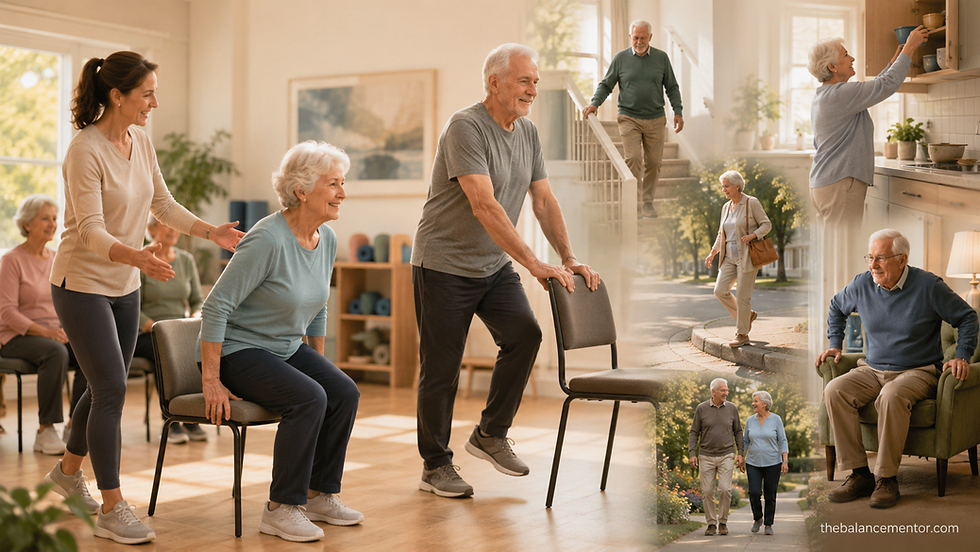
There is a big difference between being told what to do and understanding why we are doing it.
That is especially true with strength and balance exercise.
Many of us have had the experience of being given exercises without much explanation.
“Do ten of these.”
“Hold this position.”
“Repeat this every day.”
And sometimes that is fine. Clear instructions matter.
But if we do not understand why a movement is useful, it can easily feel like another task to complete.
Another thing on the list.
Another instruction from someone else.
Another health box to tick.
And when life gets busy, energy drops, motivation dips, or confidence wobbles, these kinds of tasks are often the first things to disappear.
Understanding can change that.
When we understand how an exercise is helping us, it becomes more meaningful.
A sit-to-stand is not just “getting up and down from a chair.”
It is practising one of the most useful movements in daily life.
It is linked with getting out of a dining chair, rising from the sofa, using the toilet, getting out of the car, standing up in a waiting room, or getting up safely when we are tired.
For those looking to graduate to a strength and conditioning class, it’s an introduction to doing squats.
A heel raise is not just “lifting the heels.”
It helps the calves, ankles and feet do their job.
Those muscles and joints help us walk, push off the ground, climb stairs, steady ourselves, and respond when the ground is not perfectly flat.
A balance exercise is not just “standing still and hoping for the best.”
It is helping the body and brain practise noticing, adjusting and recovering.
Because balance is not a fixed position.
It is a response. It’s dynamic.
We wobble. We notice. We adjust. We repeat.
This is skill development.
And skills improve with the right kind of practice.
This is why “knowing” and “understanding” are not quite the same thing.
We may know exercise is good for us.
We may know balance matters.
We may know strength helps.
Understanding goes a step further.
Understanding helps us connect the exercise to real life.
It helps us see the point.
It helps us notice what is happening in the body.
It helps us choose the right level for us at that moment.
It helps us make sensible adjustments instead of giving up.
It helps us practise with more awareness of what is going on.
That matters because strength and balance work is not just about copying movements.
It is about learning how the body responds.
Where is our weight going?
What happens when our feet are closer together?
What changes when we turn our head?
How much support do we need today?
Are we holding our breath?
Are we moving with control, or rushing to get it over with?
Does this feel like the right level of challenge?
These questions are not complicated.
They are practical.
They help us become more aware of our own body.
And that awareness is part of confidence.
Confidence does not come from pretending everything is fine.
It comes from understanding what we are doing, why we are doing it, and how to adapt when needed.
That is especially important as we get older.
We may be managing changes in energy, eyesight, joints, strength, balance, medication, sleep, pain, confidence or general health.
Some days we may feel steady.
Other days, less so.
Some days a movement may feel manageable.
Other days we may need more support, a smaller movement, a slower pace, or a seated version.
This is not failure.
This is great self-management.
And it is much easier to self-manage when we understand the purpose of the exercise and how it can influence our well-being.
If the aim is to practise arm strength, we can choose a seated or wall-supported version that gives the arms useful work without worrying about balance.
If the aim is to practise balance, we can use support in a way that allows the body to learn without feeling unsafe.
If the aim is to practise stamina, we can notice our effort level and use the talk test rather than pushing blindly.
If the aim is to improve confidence, we can choose a level that gives us success and challenge, not fear and frustration.
Understanding helps us work with the body instead of battling against it.
It also helps us respect the difference between effort and strain.
Good strength and balance work should involve effort.
The body needs enough challenge to adapt.
Strain may mean forcing, rushing, gripping, holding the breath, or pushing through warning signs, which in turn may lead to injury.
There is a better way.
Start where we are.
Use support when needed.
Choose the version that lets us move well.
Practise with attention.
Repeat consistently.
Progress when ready.
That may sound simple, AND it is powerful.
Because when we understand the points of an exercise, we are more likely to recognise its value outside the session.
We may notice a sit-to-stand when getting up from the sofa.
We may notice ankle strength when stepping off a kerb.
We may notice weight shift when reaching into a cupboard.
We may notice balance reactions when turning in the kitchen.
We may notice stamina when walking to the shop, climbing stairs, or carrying bags.
Suddenly the exercise is not separate from life.
It is preparation for life, And That is the real value.
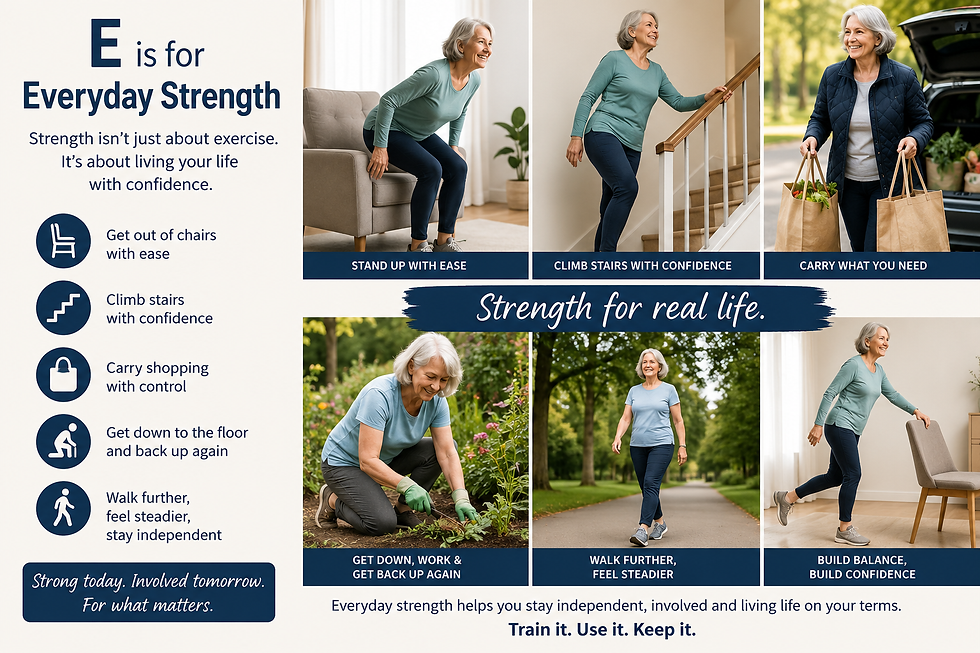
Strength and balance exercise is not about performing movements for the sake of it.
It is about practising the physical skills that help us keep doing ordinary things with more confidence.
Getting out of chairs.
Walking across a room.
Changing direction.
Reaching.
Carrying.
Climbing stairs.
Managing kerbs.
Standing in queues.
Getting outside.
Feeling more secure in our own body.
When we understand that, the exercises become less random.
They become more useful.
And useful things are easier to repeat.
This does not mean we need to know every muscle name or every technical detail.
Most of us do not need a lecture in anatomy to move well.
we do deserve clear, practical explanations.
What is this helping with?
Where might we notice it in daily life?
How hard should it feel?
What can we change if it feels too much?
How do we know when we are ready to progress?
That kind of understanding builds trust.
It helps us feel less like passive followers and more like active participants.
And that matters, because adults are not simply bodies to be instructed.
We bring experience, judgement, concerns, preferences and goals.
We deserve to understand what we are doing.
Not so we can overthink every movement.
But so we can move with more confidence, more awareness and more purpose.
There is a world of difference between:
“Do this because it is good for you.”
and:
“Practise this because it strengthens the leg muscles which helps with getting out of chairs, climbing stairs, recovering from a wobble, walking more steadily, and staying independent.”
The second one gives us a reason.
And the reasons should matter to us as individuals.
They help us pay attention, repeat, keep going when progress feels slow, and connect small movements to bigger outcomes.
When we understand the purpose, exercise stops being a random set of tasks.
It becomes preparation and a habit.
It becomes a way of building what helps us stay strong, steady and involved with what matters to us.


Comments